Google Play
 App Store

The healthcare industry generates a huge amount of information every day. Whenever a patient visits a hospital, clinic, or healthcare facility, several details are recorded. These details include the patient’s symptoms, diagnosis, treatments, medical procedures, medications, and follow-up care. Managing this information accurately is extremely important for hospitals, doctors, and insurance companies.
To organize and standardize this information, the healthcare industry uses a system called medical coding. Medical coding helps convert complex medical information into standardized codes that can be easily stored, analyzed, and used for billing and administrative purposes.
To fully understand the concept of medical coding, it is helpful to break the term into two parts: “Medical” and “Coding.” By understanding these two words separately, we can clearly see how they work together in the healthcare system.
Understanding the Meaning of “Medical”
The word “Medical” refers to anything related to medicine, healthcare, treatment, diseases, doctors, hospitals, and patient care.
In the context of medical coding, “medical” represents the healthcare information generated during the diagnosis and treatment of a patient.
Every time a patient receives medical care, a detailed record is created. This record is called medical documentation.
Medical documentation may include several types of information such as:
- Patient symptoms and complaints
- Doctor’s diagnosis
- Medical history
- Laboratory test results
- Prescriptions and medications
- Surgical procedures
- Radiology reports
- Hospital services provided
All of this information becomes part of the patient’s medical record.
For example, if a patient visits a doctor with severe stomach pain, the doctor may record details such as:
The symptoms experienced by the patient
The possible medical condition
Tests recommended to confirm the diagnosis
Treatment or medication prescribed
These details help healthcare providers understand the patient’s condition and provide appropriate treatment.
In simple terms, “medical” refers to all healthcare-related information created during patient treatment and care.
Types of Medical Information Used in Medical Coding
Medical coders work with various types of healthcare documentation. Some of the most common types include:
- Doctor’s notes and clinical documentation
- Laboratory reports
- Radiology reports such as X-rays and MRI scans
- Surgical operation reports
- Discharge summaries
- Prescription records
These documents contain important medical details that coders must carefully analyze before assigning codes.
Medical coders must have a good understanding of medical terminology, anatomy, and healthcare procedures in order to interpret these documents correctly.
Understanding the Meaning of “Coding”
The second part of medical coding is the word “Coding.”
Coding refers to the process of converting information into standardized symbols, numbers, or alphanumeric codes.
In many industries, coding is used to simplify complex information and make it easier to store, analyze, and communicate.
In healthcare, coding involves translating medical information into standardized codes that represent diagnoses, treatments, procedures, and services.
Instead of writing long descriptions repeatedly, healthcare systems use codes to represent specific medical conditions and procedures.
For example:
A disease such as diabetes has a specific code.
A procedure such as an X-ray or surgery also has a specific code.
These codes are recognized globally, allowing healthcare systems, insurance companies, and hospitals to communicate effectively.
Coding helps standardize medical data so that it can be easily processed by healthcare systems.
Why Coding is Important in Healthcare
Coding plays a critical role in healthcare administration and operations.
Some of the major purposes of coding include:
- Simplifying complex medical information
- Maintaining organized patient records
- Processing insurance claims efficiently
- Tracking healthcare data and statistics
- Supporting medical research and analysis
Without coding, hospitals and insurance companies would have difficulty managing large volumes of medical information.
Coding ensures that healthcare data remains consistent, accurate, and easy to understand across different healthcare organizations.
What is Medical Coding?
When the terms “Medical” and “Coding” are combined, the result is Medical Coding.
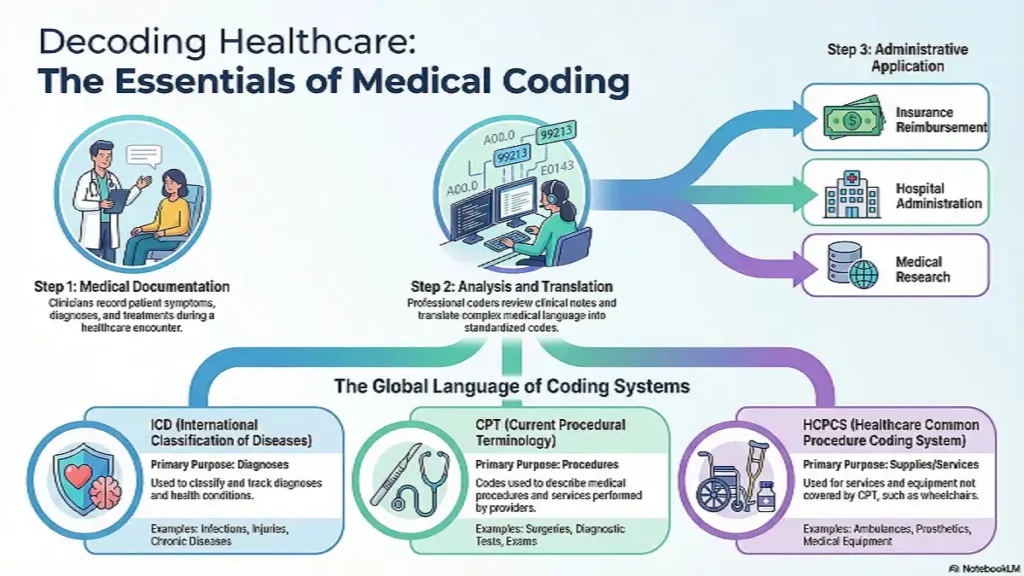
Medical coding is the process of converting healthcare diagnoses, treatments, medical procedures, and services into standardized alphanumeric codes.
Medical coders review patient records and assign the correct codes based on the information documented by healthcare professionals.
These codes are then used for:
- Insurance billing and reimbursement
- Maintaining patient records
- Hospital administration
- Healthcare research and statistics
Medical coding ensures that healthcare providers receive proper payment for the services they provide and that patient information is accurately documented.
Example of Medical Coding in Practice
To understand medical coding more clearly, consider the following example.
Imagine a patient visits a hospital after falling and injuring their arm.
The doctor examines the patient and records the following details:
Diagnosis: Fracture of the arm
Procedure: X-ray examination
Treatment: Arm cast
A medical coder reviews the doctor’s documentation and assigns standardized codes for:
- The fracture diagnosis
- The X-ray procedure
- The treatment provided
These codes are entered into the hospital’s healthcare system and used for insurance claims and medical records.
This process ensures that the treatment provided is properly documented and billed.
Standard Coding Systems Used in Medical Coding
Medical coding uses internationally recognized coding systems to ensure consistency and accuracy.
The most commonly used coding systems include:
- ICD
- CPT
- HCPCS
Each of these systems serves a specific purpose in the healthcare coding process.
ICD (International Classification of Diseases)
The ICD coding system is used to classify diseases, disorders, and health conditions.
It provides standardized codes for thousands of medical diagnoses.
For example:
- Infections
- Chronic diseases
- Injuries
- Mental health conditions
ICD codes allow healthcare providers to track diseases and maintain accurate patient records.
The most widely used version today is ICD-10.
CPT (Current Procedural Terminology)
CPT codes are used to describe medical procedures and services performed by healthcare providers.
These procedures may include:
- Surgical operations
- Diagnostic tests
- Medical examinations
- Therapeutic treatments
CPT codes help insurance companies understand what services were provided to the patient.
This allows them to process claims and reimburse healthcare providers accordingly.
HCPCS (Healthcare Common Procedure Coding System)
HCPCS codes are used for services, supplies, and equipment that are not included in CPT codes.
Examples include:
- Medical equipment such as wheelchairs
- Ambulance services
- Prosthetics and orthotics
- Durable medical supplies
HCPCS codes ensure that all aspects of healthcare services are properly documented and billed.
Role of a Medical Coder
A medical coder is a healthcare professional responsible for reviewing medical records and assigning the correct codes for diagnoses and procedures.
Medical coders carefully analyze patient documentation to ensure that the assigned codes accurately represent the services provided.
Their responsibilities include:
- Reviewing medical records
- Understanding healthcare documentation
- Assigning appropriate diagnosis and procedure codes
- Ensuring compliance with coding guidelines
- Maintaining accuracy in coding and billing processes
Medical coders play an important role in the financial and administrative operations of healthcare organizations.
Skills Required for Medical Coding
Medical coding requires several important skills and areas of knowledge.
Knowledge of Medical Terminology
Medical coders must understand medical terms related to diseases, body systems, treatments, and procedures.
This helps them interpret patient records correctly.
Understanding of Anatomy and Physiology
Knowledge of the human body and its functions is essential for identifying medical conditions and procedures accurately.
Attention to Detail
Medical coding requires high accuracy because even small errors can affect billing and insurance claims.
Analytical Skills
Coders must analyze complex medical documentation and identify the appropriate codes.
Computer Skills
Medical coders work with electronic health record systems and coding software, so basic computer knowledge is essential.
Importance of Medical Coding in the Healthcare Industry
Medical coding plays a crucial role in the healthcare system.
It supports several important functions such as:
- Accurate healthcare documentation
- Efficient insurance claim processing
- Hospital administration and management
- Public health reporting
- Healthcare research and analysis
Without medical coding, managing healthcare data would be extremely difficult.
Career Opportunities in Medical Coding
Medical coding has become a popular career choice because of the growing healthcare industry.
Medical coders can work in various organizations including:
- Hospitals
- Clinics
- Healthcare consulting companies
- Insurance companies
- Medical billing companies
- Healthcare IT firms
- Government healthcare agencies
Some medical coders also work remotely for international healthcare companies.
Benefits of a Career in Medical Coding
Medical coding offers several advantages as a profession.
Growing Demand
The healthcare industry is expanding rapidly, increasing the demand for trained medical coding professionals.
Stable Career Opportunities
Healthcare services are always required, making medical coding a stable and secure career.
Global Job Opportunities
Medical coding standards are used internationally, allowing professionals to work with global healthcare organizations.
Work-from-Home Options
Many medical coding jobs allow remote work, providing flexibility for professionals.
Future of Medical Coding
Medical coding continues to evolve with advancements in healthcare technology.
Modern healthcare systems now use:
- Electronic health records (EHR)
- Healthcare data analytics
- Artificial intelligence tools
- Automated coding assistance
Although technology can support the coding process, human expertise is still essential for interpreting complex medical documentation.
As healthcare services expand worldwide, the demand for skilled medical coders is expected to continue growing.
Conclusion
Medical coding is a vital part of the healthcare system that helps organize and standardize medical information. By breaking the term into “Medical” and “Coding,” we can clearly understand its purpose.
The word “Medical” refers to all healthcare-related information generated during patient care, while “Coding” refers to the process of converting that information into standardized alphanumeric codes.
Together, medical coding ensures that healthcare data is accurately documented, easily understood, and efficiently processed by hospitals, insurance companies, and healthcare organizations.
With the growing demand for healthcare services, medical coding has become an important profession that supports the smooth functioning of the healthcare industry and ensures proper management of medical information.

Top Courses
Top Locations
- Digital Marketing Course in Faridabad
- Digital Marketing Course in Delhi
- Digital Marketing Course in Gurgaon
- Digital Marketing Course in Noida
- Web Development Course in Faridabad
- Web Development Course in Delhi
- Web Development Course in Gurgaon
- Web Development Course in Noida
- Graphic Design Course in Faridabad
- Python Course in Gurgaon
- SEO Course in Noida