Google Play
 App Store

By Skill For Career | View All Courses →
Let me be straight with you.
When I first started looking into video editing courses, I was completely overwhelmed. There were YouTube tutorials, paid Udemy courses, fancy institutes in Delhi, and everything in between. Everyone claimed to be the best. Nobody told me what I actually needed to know as a complete beginner.
So I’m going to skip the fluff and tell you exactly what works — what tools you should learn, what courses are actually worth it, and how people in cities like Noida, Faridabad, and Dehradun are using video editing to build real careers and freelance income right now.
Whether you want to edit YouTube videos, land a job at a digital agency, work in the Bollywood-adjacent industry, or just start freelancing on the side — this guide is for you.
| Quick answer: The best video editing course for beginners is one that teaches industry tools (like Premiere Pro or DaVinci Resolve), gives you real project work, and connects you with actual job opportunities. Scroll down and I’ll explain exactly how to find that — and why most people get this wrong. |
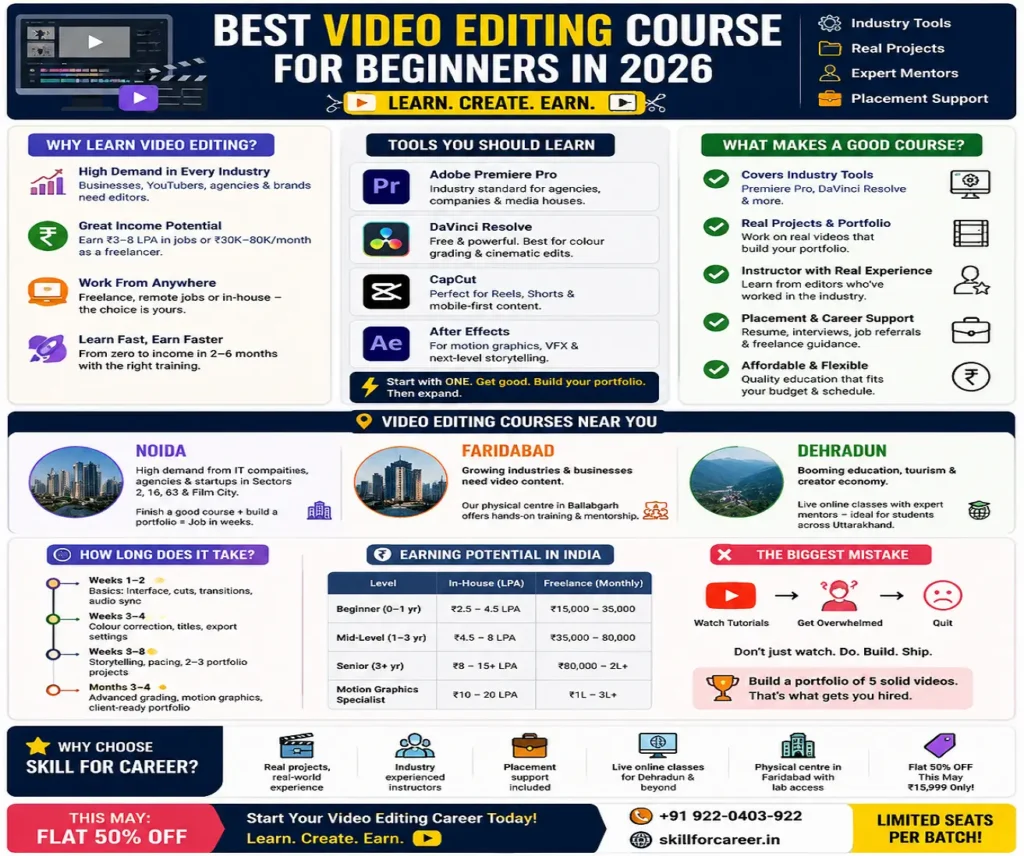
First, Let’s Talk About Why Video Editing Is Worth Learning Right Now
I know what you’re thinking — “Isn’t everyone doing this already?”
Short answer: No. And that’s actually good news for you.
Yes, there are thousands of YouTube creators and Instagram reels popping up every day. But here’s the thing — most of them are terrible at editing. They’re shooting raw footage and throwing it online. The moment you can deliver a clean, well-paced, properly colour-graded video, you immediately stand out.
Businesses across India — especially in growing cities like Noida’s tech corridor, Faridabad’s industrial belt, and Dehradun’s booming education and tourism sector — are desperately looking for people who can create professional video content. Social media managers, digital marketing agencies, YouTube channels, real estate companies, coaching institutes… they all need video editors.
And here’s the income angle nobody talks about enough: a mid-level video editor in India earns anywhere from ₹3–8 LPA in-house. Freelancers who’ve built a decent portfolio often make ₹30,000–80,000 a month working from home. That’s not a bad deal for a skill you can learn in 2–3 months.
| Real talk: One of our students from Faridabad — a commerce graduate with zero tech background — finished a 3-month designing course, built a portfolio of 5 edited videos, and landed a ₹22,000/month job at a digital agency in Delhi within 6 weeks of completing the course. This stuff is real. |
What Makes a Video Editing Course Actually Good for Beginners?
Here’s the problem with most beginner video editing courses: they teach you features, not skills.
There’s a big difference between knowing where the ‘trim’ button is and knowing how to tell a story through editing. The best courses teach you both — the technical side and the creative side.
Here’s what I’d look for before enrolling in anything:
1. It Covers Real Industry Tools
If the course only teaches you to use iMovie or some unknown free software, walk away. In the real job market — whether you’re applying to agencies in Noida’s Sector 63, production houses near Faridabad, or remote companies hiring from Dehradun — employers want to see Adobe Premiere Pro, DaVinci Resolve, or Final Cut Pro on your resume. These are the tools that matter.
2. You Get to Work on Real Projects
No amount of watching tutorials will make you a video editor. You need to actually edit videos. A good course will have you working on short films, promotional videos, travel vlogs, product ads — real stuff that goes into your portfolio.
Your portfolio is everything when you’re starting out. No employer cares about your certificate as much as they care about seeing what you’ve actually made.
3. The Instructor Has Done This in the Real World
Be honest with yourself: do you want to learn video editing from someone who’s edited brand campaigns, music videos, or corporate content? Or from someone who watched YouTube tutorials and decided to make a course?
Check if the instructor has a portfolio. Look for real-world experience. This is non-negotiable.
4. There’s Some Kind of Placement or Career Support
This is especially important if you’re in a city that’s not a major metro. If you’re in Dehradun, finding video editing gigs locally is harder than if you’re sitting in Mumbai. A good institute will help you with resume building, connecting you to remote freelance opportunities, or at minimum — give you a certificate that opens doors.
At Skill For Career, placement support is baked into every course. We’ve seen students from Tier 2 cities land remote editing jobs paying more than local office salaries — because we helped them position themselves correctly.
5. It Fits Your Budget and Schedule
An ₹80,000 full-time course is overkill if you’re just testing the waters. But a ₹500 Udemy course with zero mentorship isn’t going to get you a job either. The sweet spot is a structured course with expert instruction, real projects, and career support — at a reasonable price.
Right now, all courses at Skill For Career are available at flat 50% off — just ₹15,999. That’s a pretty good deal for what you get.
The Tools You Need to Actually Learn
Let’s talk tools. Here’s what the industry actually uses — and what you should learn as a beginner.
Adobe Premiere Pro — The Job Market Standard
If you want to work for a company — an ad agency in Noida, a production house in Delhi, a media company anywhere in India — there’s a very high chance they’re using Premiere Pro. It’s the industry standard for video editing in India’s corporate and agency world.
It’s not free. Adobe charges around ₹1,600/month. But most professional courses give you access during the course, so you can learn before committing to a subscription.
Learn Premiere Pro if: you want a job at a company, agency, or media house.
DaVinci Resolve — The Free Powerhouse
DaVinci Resolve is completely free (the paid Studio version exists, but you won’t need it for a long time). It’s genuinely powerful — used by Hollywood films and Indian OTT productions.
It’s particularly famous for colour grading, which is a high-value niche in itself. If you want to specialize in making videos look cinematic, DaVinci is your tool.
Many beginners in Dehradun and smaller cities choose DaVinci specifically because the software is free — they can practice on their own laptop without any ongoing cost.
Learn DaVinci if: you want a free, powerful tool or you’re interested in colour grading.
CapCut — For Reels, Shorts, and Mobile-First Creators
CapCut has exploded in popularity for a reason. If you want to create Instagram Reels, YouTube Shorts, or quick social media content — CapCut lets you do it from a phone or laptop in minutes.
It won’t get you a job at a production house. But it will help you if you’re a content creator, manage a brand’s social media, or want to start building a freelance client base quickly.
After Effects — Motion Graphics (Next Level)
After Effects isn’t really a video editor — it’s a motion graphics and visual effects tool. But a beginner course that introduces you to After Effects alongside Premiere Pro is a huge bonus. Motion graphics editors are among the highest-paid people in India’s digital advertising industry.
| Don’t try to learn all of these at once. Pick one — ideally Premiere Pro or DaVinci Resolve — get good at it, build a portfolio, then expand. That’s the path that actually leads to income. |
City-by-City Breakdown: Video Editing Courses Near You
Let me talk to you specifically based on where you are — because the strategy is a little different depending on your city.
Video Editing Course in Noida
Noida is a fantastic city to be in if you’re learning video editing. You’ve got a dense cluster of IT companies, digital marketing agencies, e-commerce startups, and content studios in Sectors 2, 16, 63, and around Film City.
The demand is real. Companies in Noida want editors who can turn around branded content fast — product videos, explainer videos, social media ads. If you’re in Noida and you finish a solid Premiere Pro course with 4–5 portfolio pieces, you can land an interview within weeks.
Our online programmes let Noida-based students learn from industry experts while staying close to the job market. Check out available courses here →
Video Editing Course in Faridabad
Faridabad often gets overlooked compared to Gurugram and Delhi — but that’s honestly an advantage right now. The city’s manufacturing and industrial businesses are increasingly investing in digital marketing, which means there’s growing demand for video content creators locally.
More importantly, you’re 30–40 minutes from South Delhi and Gurugram’s agency belt. A good portfolio built in Faridabad can easily land you a job in either of those markets.
Skill For Career’s physical training centre is based in Ballabgarh, Faridabad. Students here get hands-on classroom access, lab time, and direct mentorship from instructors. It’s probably the most practical setup for beginners who need real face-to-face feedback. Explore what we offer →
Video Editing Course in Dehradun
Dehradun is a different story — and I mean that in a good way.
The city has a massive student population, a booming tourism industry, and a growing number of coaching institutes and educational brands — all of whom need video content. YouTube channels documenting Uttarakhand’s beauty, travel reels, documentary-style content — there’s a real creative economy here.
The challenge is that offline video editing institutes in Dehradun are still limited. Most serious learners end up going with online courses, which is honestly fine — the quality of online instruction has gotten really good.
If you’re in Dehradun, I’d recommend a live online instructor-led course over self-paced tutorials. You need someone to give you feedback on your actual edits — something a pre-recorded course simply can’t do.
We have students from Dehradun and across Uttarakhand enrolled in our online batches. Talk to our team about the right course for you →
How Long Does It Actually Take to Learn Video Editing?
This is the question everyone asks and nobody gives a straight answer to. So here’s mine:
You can learn enough to start freelancing in 6–8 weeks. You can be genuinely employable in 3–4 months.
That’s assuming you’re putting in 2–3 hours a day and actually editing — not just watching tutorials.
Here’s a rough timeline for a beginner:
→ Weeks 1–2: Interface, basic timeline editing, cuts, transitions, audio sync
→ Weeks 3–4: Colour correction basics, text & titles, export settings
→ Weeks 5–8: Storytelling through editing, pacing, your first 2–3 portfolio projects
→ Months 3–4: Advanced colour grading, motion graphics intro, building client-ready portfolio
After month 4, you shouldn’t be looking for courses. You should be looking for clients or jobs.
What Can You Actually Earn as a Video Editor in India?
Let’s talk money — because that’s why you’re here.
| Beginner (0–1 yr) | ₹2.5 – 4.5 LPA | ₹15,000 – 35,000 |
| Mid-Level (1–3 yr) | ₹4.5 – 8 LPA | ₹35,000 – 80,000 |
| Senior (3+ yr) | ₹8 – 15+ LPA | ₹80,000 – 2L+ |
| Motion Graphics Specialist | ₹10 – 20 LPA | ₹1L – 3L+ |
These aren’t fantasy numbers. Students from Faridabad, Noida, and Dehradun who’ve gone through structured courses and built a proper portfolio are hitting these figures. Freelancers especially — once you start working with international clients via Upwork or Fiverr, the income potential goes up significantly even from a smaller city.
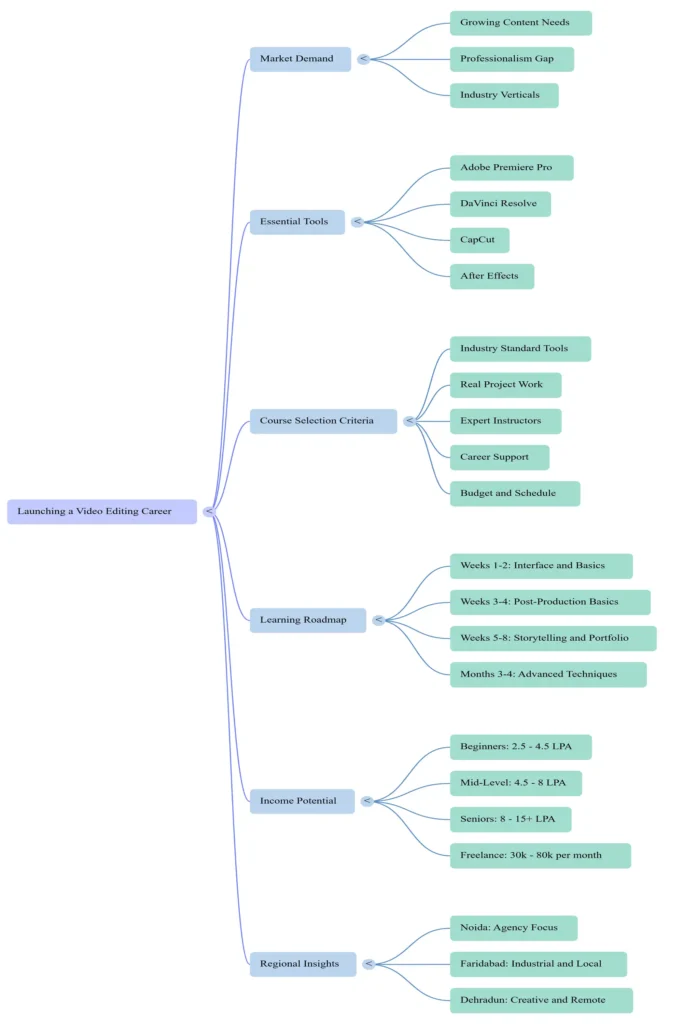
The Mistake Most Beginners Make (Please Don’t Do This)
I’ve seen this pattern over and over again: someone starts watching free YouTube tutorials on video editing, learns 40% of a tool, gets overwhelmed, quits, and says “video editing isn’t for me.”
It wasn’t the skill that failed them. It was the approach.
Free tutorials are great supplements, but they’re terrible primary teachers. There’s no structure, no feedback loop, no accountability, and no portfolio at the end. You end up knowing random features rather than knowing how to actually make something — which is all that matters.
The students who succeed fastest are the ones who commit to a structured course, do every project, ask for feedback, and ship something even when it’s imperfect.
| The goal isn’t to become perfect at editing. The goal is to build a portfolio of 5 solid videos that prove you can do the work. That’s what gets you hired or gets you clients — not a certificate, not knowing every keyboard shortcut. |
Why Students Choose Skill For Career for Video Editing Training
I’ll be upfront — Skill For Career is our platform. But I’m also going to be honest about exactly what we offer and why it works for beginners.
We’re a job-oriented skills training institute based in Ballabgarh, Faridabad, with students across India — including large batches from Noida, Dehradun, and the wider Delhi NCR region. Our entire philosophy is simple: you should leave our course with real skills and a real shot at a job or freelance income. Not just a certificate to hang on a wall.
→ Real projects, not just assignments — You’ll edit actual promotional videos, travel content, and brand reels — not made-up practice files.
→ Instructors who’ve done the work — Our video editing instructors have worked with brands, YouTube channels, and media houses. They’ll give you feedback that matters.
→ Placement support included — Resume review, portfolio guidance, interview prep, and job referrals — especially useful if you’re not in a major metro.
→ Online batches for Dehradun and beyond — Live, instructor-led classes. Not pre-recorded. You ask questions, get answers, and get feedback on your actual edits in real time.
→ Physical centre in Faridabad for hands-on learners — If you’re local to Faridabad or commuting from Noida/Delhi, the classroom experience with lab access is hard to beat.
→ 50% off this May — All courses at ₹15,999. Check if the offer is still live: skillforcareer.in/course.
We also offer scholarships for eligible students — so cost shouldn’t be the reason you don’t start.
Curious but not ready to commit? Read what our students actually say →
Frequently Asked Questions
Do I need a powerful computer to learn video editing?
Not necessarily to start. DaVinci Resolve and Premiere Pro work on mid-range laptops. You’ll want at least 8GB RAM (16GB is better), an SSD, and a decent processor — ideally i5 or Ryzen 5 and above. You don’t need to buy a new laptop to get started.
I’m in Dehradun. Is an online video editing course good enough?
100% yes — if it’s live and instructor-led, not just pre-recorded videos. The key is getting actual feedback on your edits. We have students from Dehradun, Haridwar, and Rishikesh who’ve landed remote editing gigs without ever attending a class in person.
Is video editing a sustainable career or just a trend?
Video content isn’t going anywhere. If anything, demand is growing — OTT platforms, YouTube, Instagram Reels, corporate training videos, news channels, real estate tours. The applications are expanding, not shrinking. This is a sustainable career for the next decade at minimum.
How is Skill For Career different from Udemy or YouTube tutorials?
Udemy and YouTube are great for reference, but they don’t give you feedback, accountability, or a community. You watch, you feel like you learned something, you close the laptop — and three weeks later you haven’t edited a single video. Our courses are structured, live, and project-based. There’s a big difference in outcomes.
Can I start freelancing while still in the course?
Many of our students pick up their first client around weeks 6–8 — often someone from their own network who needs a simple video edited. We actively encourage this. Getting paid for your work while still learning is the fastest way to grow your confidence and your skills.
Here’s What You Should Do Next
I know this was a long read. Let me boil it down.
If you’re serious about learning video editing in 2026:
→ Pick one tool — Premiere Pro if you want agency work, DaVinci Resolve if you want the free route.
→ Join a structured, live course with real projects and real feedback. Not just tutorials.
→ Build a portfolio of 5 videos before you look for a single job or client.
→ If you’re in Faridabad — come to our physical centre. If you’re in Noida or Dehradun — join our online batches.
→ Don’t wait for the ‘perfect time.’ Start this month.
Video editing is one of those rare skills where you can go from zero to income in under 6 months. That’s not hype — that’s what our students’ stories actually show. If you want to see those stories before committing, read our student testimonials here.
Ready to start? Browse all courses at Skill For Career →
Have questions before enrolling? Get in touch with our team → We reply fast.
| �� This May: Flat 50% OFF on all courses — only ₹15,999. Limited seats per batch. Call +91 922-0403-922 or visit skillforcareer.in to enrol. |
Top Courses
Top Locations
- Digital Marketing Course in Faridabad
- Digital Marketing Course in Delhi
- Digital Marketing Course in Gurgaon
- Digital Marketing Course in Noida
- Web Development Course in Faridabad
- Web Development Course in Delhi
- Web Development Course in Gurgaon
- Web Development Course in Noida
- Graphic Design Course in Faridabad
- Python Course in Gurgaon
- SEO Course in Noida