Google Play
 App Store

By Skill For Career | Medical Coding Exam Guidance Program | Faridabad & Noida
If you are preparing for the CPC exam in India, there is a good chance you have already spent hours watching YouTube videos, downloaded a few PDFs, bookmarked the AAPC website, and still feel like you are not sure where to actually start.
That feeling is not a lack of intelligence. It is a lack of structure.
We have been training medical coding students at Skill For Career since we opened our doors, and we see the same three struggles walk through our door every single batch—fear of the exam format, confusion between CPT and ICD-10-CM coding, and shaky anatomy knowledge. In that order.
This guide is going to address all three and a lot more. By the end, you will know exactly what the CPC exam tests, why most self-study attempts fail, what an 88–92% pass rate program actually looks like from the inside, and how to decide—honestly—whether you are ready to start preparing right now.
What Is the CPC Exam, and Why Does It Matter in India?
The AAPC—the American Academy of Professional Coders—issues the CPC (Certified Professional Coder) credential. In fact, it is the only certification for medical coding that is publicly recognized in physician office settings and has been renewed as the industry standard credential for obtaining medical coding jobs in India.
Here’s what an actual exam looks like:
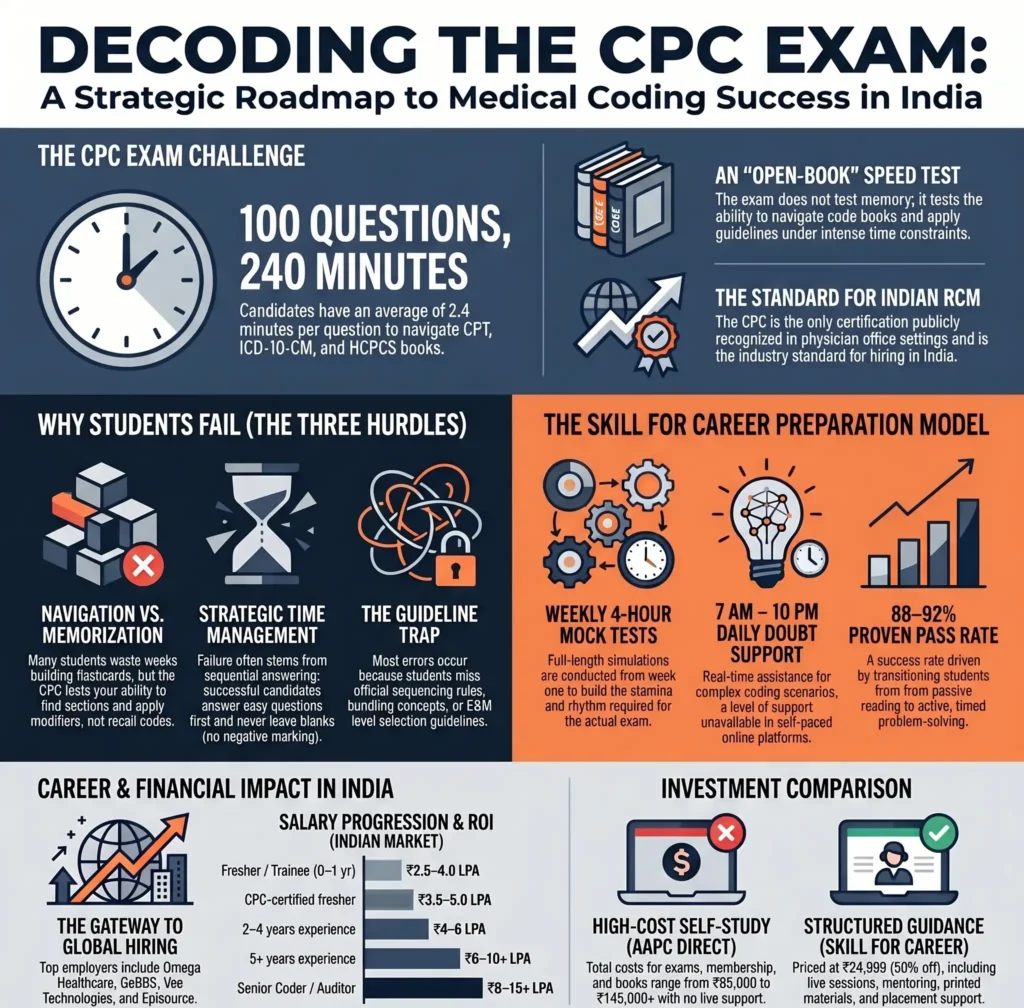
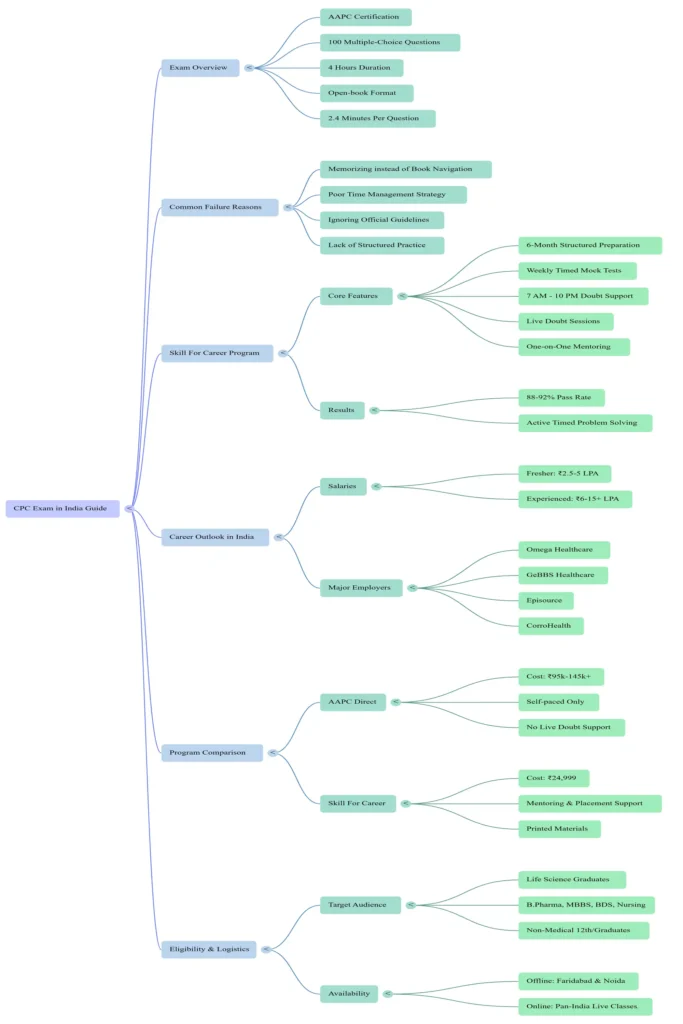
- 100 multiple-choice questions
- 4 hours to complete
- Open-book—bring your CPT, ICD-10-CM & HCPCS code books
- Includes anatomy, medical terminology, ICD-10-CM, CPT, HCPCS, and compliance guidelines
“Looking for a structured program that covers all of this from the ground up? See our Medical Coding Detailed Study Course for students who want to start from foundations.”
That open-book format snares many first-time candidates. Yeah, people hear “open book” and think “easy.” It does not. The exam is ABOUT testing your ability to walk through the code books at speed, NOT remembering codes from memory. You will run out of time—guaranteed—unless you have trained yourself to find answers quickly under time constraints.
The math is brutal: 100 questions in 4 hours translates to about 2.4 minutes on each question, on average. A lot of them ask you to search multiple codes, check guidelines, and rule out the distractors. That is not just a casual exercise.
The Three Reasons Most Indian Students Fail the CPC Exam
After working with hundreds of students, these are the real reasons — not the ones people admit to on forums.
1. They memorize codes instead of learning to use the codebooks.
This is the single biggest mistake we see, and it is completely understandable. Medical coding sounds like it should involve memorizing codes. So students spend weeks building flashcards, writing out code ranges, and drilling numbers into their heads.
Then they sit in the exam hall and run out of time.
The CPC is an open-book exam. You are not expected to memorize thousands of codes. What you are tested on is your ability to:
- Find the correct section quickly
- Follow coding guidelines precisely
- Use parenthetical notes correctly
- Apply modifiers appropriately
- Eliminate wrong answer choices efficiently
A student who knows where to look will consistently outscore a student who has memorized more codes. This is one of the first things we correct in our Exam Guidance Program—we train code book navigation as a skill, not an afterthought.
“You can read more about what separates a good medical coding institute in Faridabad and Delhi from one that just teaches you to memorise.”
2. Poor time management strategy
Most self-study candidates have no exam strategy. They approach questions sequentially, spend 8–10 minutes on a hard surgical case, get anxious, lose rhythm, and leave easy questions unanswered at the end.
What successful candidates do instead:
- Answer easy questions first
- Mark difficult questions and return to them
- Never leave a question blank—there is no negative marking on the CPC
This sounds obvious when written down. It is surprisingly rare in practice.
3. Ignoring official AAPC guidelines
Many exam questions are not really testing whether you can look up a code. They are testing whether you know the official guidelines—ICD-10-CM sequencing rules, modifier usage, bundling and unbundling concepts, evaluation & management rules, and surgical package concepts.
Students often find the correct code but select the wrong answer because they missed a guideline. This is especially common in questions involving the following:
- ICD-10-CM sequencing rules
- Modifier 25, 51, 59, and the XE/XS/XP/XU modifiers
- Bundling/unbundling concepts
- E&M level selection
What Our Medical Coding Exam Guidance Program Actually Covers
Our 6-month Exam Guidance Program at Skill For Career is built specifically around the three failure points above. Here is what the program includes:
Weekly Mock Tests
Every week, students sit for timed practice exams that mirror the real CPC format—100 questions, 4 hours, open book. We do not give you a practice quiz with 10 questions and unlimited time. We simulate the actual exam experience from week one so that by the time you sit for the real exam, it feels familiar.
Doubt Sessions From 7 AM to 10 PM
This is something no online platform — including AAPC’s own courses — offers. If you are studying at 8 PM and you hit a confusing modifier question, you can reach us. Our doubt support runs from 7 in the morning to 10 at night, seven days a week during your program. You are never stuck waiting until the next scheduled session.
Live Doubt Sessions
In addition to the extended support window, we conduct scheduled live doubt-clearing sessions where instructors work through commonly missed question types, tricky coding scenarios, and guideline interpretation in real time.
One-on-One Mentoring
Every student gets individual attention. If your weak area is surgical coding and your batchmate struggles with E&M, you both get targeted help—not the same generic content.
Printed Materials and Recorded Video
You get printed study materials you can annotate and take to your exam center. All sessions are recorded so you can revisit any concept as many times as you need, at your own pace.
Not sure which medical coding course is right for you—the exam guidance program or the detailed study course? Our Medical Courses page has a full comparison
A Story We See Again and Again
Let us tell you about a type of student we see regularly — and we use a composite here because this story belongs to many people.
Priya comes to us six months after finishing her B.Pharma. She found a medical coding course online, studied on and off for four months, and attempted the CPC exam. She did not pass. Not because she was unprepared in terms of knowledge—she could explain ICD-10-CM categories, she understood anatomy reasonably well, and she knew what CPT modifiers were for.
She failed because she ran out of time. She had never done a full 4-hour timed practice exam. She had never learned to tab her code books for speed. She had spent her preparation time reading chapters instead of solving questions.
When she joined our program, the first thing we changed was her approach: from passive reading to active timed problem-solving. Within six weeks, her time-per-question dropped from 5+ minutes to under 3. By month four, she was consistently passing mock tests. She cleared the CPC on her next attempt.
This is not a rare outcome. It is what structured preparation produces.
What Does a CPC Certification Actually Pay in India?
Before you invest time and money into exam preparation, you deserve a clear answer on what the return looks like. Here is what the data shows for CPC-certified coders in India:
| Experience Level | Typical Salary |
| Fresher / Trainee (0–1 year) | ₹2.5–4.0 LPA |
| CPC-certified fresher (no experience) | ₹3.5 – 5 LPA |
| 2–4 years experience | ₹4–6 LPA |
| 5+ years experience | ₹6–10+ LPA |
| Senior Coder / Auditor / Team Lead | ₹8–15+ LPA |
Companies in India that actively hire CPC-certified coders include Omega Healthcare, GeBBS Healthcare, Vee Technologies, Access Healthcare, MiraMed Ajuba, Episource, Sagility, and CorroHealth, among many others.
The sectors hiring most actively are healthcare BPO/KPO companies, revenue cycle management firms, hospital chains, health insurance companies, US healthcare outsourcing firms, and clinical research organizations.
A CPC certification does not guarantee a high salary immediately. But it opens the door to interviews and gives you a credible starting point that a non-certified candidate simply does not have. After 2–3 years, experience becomes the bigger factor — but the certification gets you those first 2–3 years.
“If you are comparing career options, see our breakdown of the top IT skills companies are hiring for in 2026 — medical coding features prominently alongside data and development roles.”
Who Is This Program For?
Our Exam Guidance Program is designed for:
- Students who have basic medical coding knowledge and are ready to focus on exam preparation
- People who attempted the CPC exam and did not pass and need a structured second attempt
- Working professionals who are switching into medical coding from another healthcare role
- Fresh graduates from B.Pharma, B.Sc, MBBS, BDS, nursing, or any life sciences background
- Non-medical graduates with an interest in healthcare data and willingness to learn the terminology
Minimum requirements are simple: 12th pass or graduation, basic English comprehension, basic computer skills (MS Excel, internet), and a willingness to commit to the study schedule.
“Even if you are from a non-medical background, starting with a job-oriented skill course is one of the most practical career moves available today — see why in our guide on building skills that actually get you hired.”
No prior coding experience is required.
How Our Program Compares to Preparing Through AAPC Directly
AAPC is the body that conducts the CPC exam. They also sell preparation materials. Here is what that costs if you go directly:
- CPC exam fee (2 attempts): approximately ₹41,000
- AAPC membership: approximately ₹19,000
- Study guide + practice exams + online review: approximately ₹35,000–85,000
- Total: ₹95,000 to ₹145,000+
And what do you get? Self-paced video content. No live sessions. No doubt support. No mock test feedback. No placement assistance. No one is available at 9 PM when you are stuck on a bundling question.
Our 6-month Exam Guidance Program is priced at ₹24,999 — currently 50% off the original price of ₹35,000.
For that, you get structured curriculum, weekly mock tests, 7 AM–10 PM doubt support, live sessions, one-on-one mentoring, printed materials, recorded content, and placement support.
We are based in Faridabad and Greater Noida, with online batches available pan-India. If you are local, read our detailed guide on choosing the best medical coding institute in Faridabad to understand what to look for before you enroll anywhere.
We are not saying AAPC’s materials are bad — they are excellent reference materials. We are saying that materials alone are not the same as a program designed to get you through the exam.
| Experience Level or Program Feature | Description or Salary Range | Duration or Quantity | Location or Availability | Key Guidelines or Skills | Pass Rate (Inferred) | |
| Skill For Career Exam Guidance Program | ₹24,999 (Current offer) | 6 Months | Online (Pan-India) & Offline (Faridabad, Noida) | Time management, mock tests, 7 AM-10 PM doubt support | 88–92% | |
| CPC Exam Format | Standard certification exam for physician offices | 100 multiple-choice questions; 4 hours | AAPC Authorized Centers | Open-book navigation of CPT, ICD-10-CM & HCPCS | 70% (Standard AAPC passing score requirement) | |
| AAPC Direct Preparation | ₹95,000 to ₹145,000+ | Self-paced | Online | Self-study, video content, AAPC materials | 60-65% (Typical industry average for self-study) | |
| CPC-certified fresher | ₹3.5 – 5 LPA | No experience | India | AAPC Certified Professional Coder credential | 88–92% (for program graduates) | [1] |
| Senior Coder / Auditor / Team Lead | ₹8–15+ LPA | Varies (Seniority) | India | Advanced coding, auditing, team leadership | Not in source | [1] |
| Experienced Coder | ₹6–10+ LPA | 5+ years | India | Long-term industry experience | Not in source | [1] |
| Mid-level Coder | ₹4–6 LPA | 2–4 years | India | Medical coding experience, guideline application | Not in source | [1] |
| Fresher / Trainee (0–1 year) | ₹2.5–4.0 LPA | 0–1 year | India | Basic medical coding knowledge | Not in source | [1] |
We Are Available Both Online and Offline
Our offline classes run from our centers in Faridabad (NIT-3, near DAV College) and Greater Noida (Sector 4, Galaxy Blue Plaza). Students from across India join us online through live classes and access to all recorded content.
Whether you are in Delhi NCR or studying from another state entirely, the program experience is the same.
The Question Every Fence-Sitter Should Ask Themselves
We work with a lot of students who tell us they want to “self-study for a few months first” and then join a program later. That is a completely valid choice. But before you make it, be honest with yourself about these four things:
Can you say yes to all of these right now?
- “I will study 8–10 hours every week.”
- “I have a complete syllabus I am following.”
- “I have timed practice exams to work from.”
- “I have a target exam date booked.”
If you can say yes to all four, self-study can absolutely work. Plenty of disciplined candidates have passed the CPC on their own.
But if those things are not in place — if you are still “doing research,” still “planning to start,” still waiting for things to settle down — then it is worth asking yourself one honest question:
What exactly will be different three months from now that will make me start studying if I am not starting now?
If the answer is concrete and specific — “I finish my final exams in August, then I have a clear six months” — then waiting is reasonable.
If the answer is vague — “I’ll feel more ready,” “I’ll do more research,” “things will calm down” — then the delay itself is the obstacle. Most people do not wake up three months later with more time, more motivation, and a clearer plan than they have today.
The biggest predictor of CPC exam success is not whether you self-study or join a program. It is whether you have a structured plan, regular practice, and a fixed exam date that turns preparation from an intention into a commitment.
Our Pass Rate
We are transparent about our numbers: students who complete our Medical Coding Exam Guidance Program pass the CPC exam at a rate of 88–92%.
That is not a magic number. It is the result of weekly mock tests, early identification of weak areas, consistent doubt support, and a study structure that mirrors what the actual exam demands.
Ready to Start?
If you are serious about clearing the CPC exam and want a structured program with a proven track record, we would be glad to speak with you.
Skill For Career—Medical Coding Exam Guidance Program
- Duration: 6 Months
- Mode: Online + Offline (Faridabad & Greater Noida)
- Fee: ₹24,999 (currently 50% off)
- Doubt Support: 7 AM – 10 PM daily
- Pass Rate: 88–92% for CPC
📞 Call or WhatsApp: +91 922-0403-922 🌐 Visit: skillforcareer.in 📍 Branch 1: 3H-47, Near DAV College, NIT-3, Faridabad 📍 Branch 2: 3rd Floor, Galaxy Blue Plaza, Sector 4, Greater Noida
Also recommended reading:
- Medical Coding Explained: What It Means and Its Role in Healthcare — Start here if you are new to medical coding
- Best Medical Coding Institute in Faridabad & Delhi: Honest Guide 2026 — What to check before joining any institute
- Medical Coding Detailed Study Course — For students who need foundations before exam prep
- Top IT Skills Companies Are Hiring For in 2026 — How medical coding fits the broader job market


Top Courses
Top Locations
- Digital Marketing Course in Faridabad
- Digital Marketing Course in Delhi
- Digital Marketing Course in Gurgaon
- Digital Marketing Course in Noida
- Web Development Course in Faridabad
- Web Development Course in Delhi
- Web Development Course in Gurgaon
- Web Development Course in Noida
- Graphic Design Course in Faridabad
- Python Course in Gurgaon
- SEO Course in Noida