Google Play
 App Store

In the modern business world, technology has changed the way companies communicate with customers. Traditional advertising methods like newspapers, television, and billboards are no longer the only ways to promote products and services. Today, businesses rely heavily on digital platforms to reach their target audience. This approach is known as Digital Marketing.
To fully understand digital marketing, it is helpful to first explore the two words that make up the term: “Digital” and “Marketing.” Once we understand these concepts individually, it becomes easier to see how they combine to create a powerful marketing strategy used by businesses worldwide.
Understanding the Meaning of “Digital”
The word digital refers to technology that processes, stores, and transmits information electronically. Digital systems operate using binary data (0s and 1s) to represent information.
In everyday life, digital technology is present everywhere. Devices and platforms that operate electronically are considered digital.
Examples include:
- Smartphones
- Computers and laptops
- Tablets
- Smart televisions
- Mobile applications
- Websites and blogs
- Social media platforms
- Online communication tools
Digital technology allows people to access information, communicate, and perform tasks through the internet.
Some common digital platforms include:
- Search engines like Google, Bing, and Yahoo
- Social media platforms like Facebook, Instagram, LinkedIn, and Twitter
- Video platforms like YouTube
- Email services like Gmail and Outlook
- Online marketplaces and e-commerce websites
- Mobile apps
Because most people now spend a significant amount of time online, digital platforms have become one of the most effective places for businesses to interact with potential customers.
Understanding the Meaning of “Marketing”
Marketing refers to the activities that businesses use to promote and sell their products or services. It involves understanding customer needs and creating strategies that encourage customers to purchase a product or service.
Marketing is not limited to advertising. It includes several important processes such as:
- Market research
- Product development
- Pricing strategy
- Promotion and advertising
- Distribution and sales
- Customer relationship management
The main goal of marketing is to connect businesses with their target audience and influence purchasing decisions.
Traditional marketing methods include:
- Television advertisements
- Radio promotions
- Newspaper and magazine ads
- Billboards and outdoor advertising
- Printed brochures and pamphlets
- Trade shows and events
Although these methods can still be effective, they often require large budgets and provide limited ways to measure results.
With the rise of the internet, marketing has evolved into a more targeted, measurable, and interactive approach known as digital marketing.
What is Digital Marketing?
Digital marketing is the process of promoting products, services, or brands using digital technologies and online platforms.
It uses the internet, mobile devices, search engines, social media, and other digital channels to reach potential customers.
In simple terms:
Digital Marketing = Marketing through digital platforms and technologies.
Unlike traditional marketing, digital marketing allows businesses to:
- Reach a global audience
- Target specific customer groups
- Measure campaign performance accurately
- Interact directly with customers
- Adjust strategies quickly
Because of these advantages, digital marketing has become an essential part of modern business strategies.
Types of Marketing in Digital Marketing
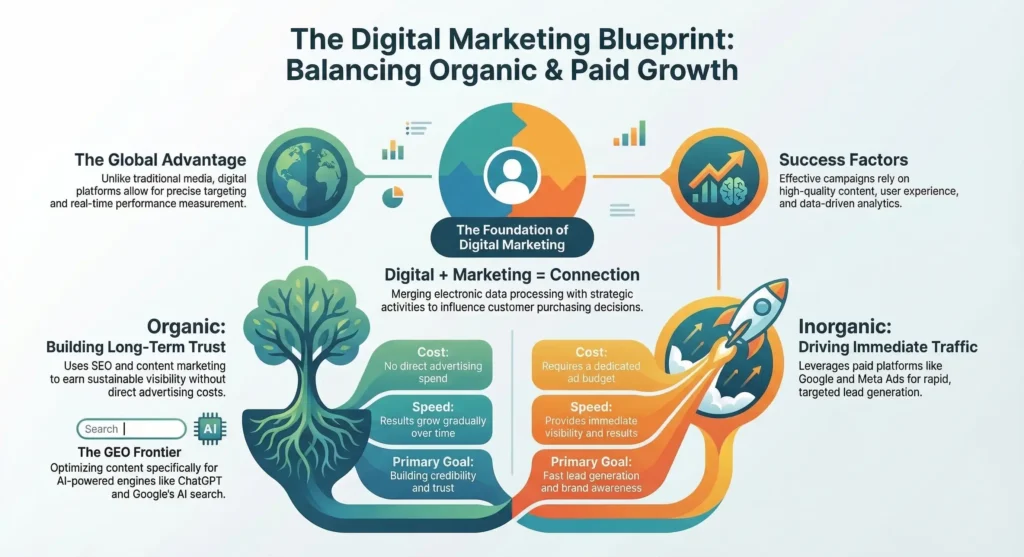
In digital marketing, promotional strategies are generally divided into two major categories:
Organic Marketing
Inorganic Marketing (Paid Marketing)
Both methods aim to attract customers, but they differ in cost, speed, and long-term impact.
Organic Marketing (Free Marketing)
Organic marketing refers to marketing methods that attract customers without paying directly for advertisements. Instead of buying visibility, businesses focus on building trust, creating valuable content, and optimizing their digital presence.
Organic marketing takes more time to show results, but it creates long-term and sustainable growth.
Characteristics of Organic Marketing
- No direct advertising cost
- Focus on long-term results
- Builds brand credibility and trust
- Relies on content and optimization
- Traffic grows gradually over time
Several strategies fall under organic marketing.
Search Engine Optimization (SEO)
Search Engine Optimization (SEO) is the process of improving a website so that it ranks higher on search engines like Google, Bing, or Yahoo.
When users search for information or products online, search engines display results based on relevance and quality. SEO helps websites appear among the top results.
SEO involves several techniques:
- Keyword research
- On-page optimization
- Technical SEO
- Link building
- Content optimization
For example, if a user searches for “best digital marketing course”, an SEO-optimized website may appear on the first page of Google without paying for advertisements.
The main goal of SEO is to increase organic traffic to a website.
Generative Engine Optimization (GEO)
Generative Engine Optimization (GEO) is a newer concept in digital marketing that focuses on optimizing content for AI-powered search engines and generative AI platforms.
Modern users often rely on AI tools such as ChatGPT, Perplexity, or Google’s AI search experience to find answers.
GEO ensures that your content is structured in a way that AI systems can understand and reference it when generating responses.
Key practices of GEO include:
- Writing clear and well-structured content
- Providing authoritative and accurate information
- Using question-based content
- Organizing information logically
- Adding context and detailed explanations
As artificial intelligence becomes more integrated with search technology, GEO is becoming an important part of organic marketing strategies.
Content Marketing
Content marketing focuses on creating valuable, informative, and engaging content to attract potential customers.
Instead of directly selling products, businesses provide useful information that solves problems or answers questions.
Examples of content marketing include:
- Blog articles
- Educational videos
- Infographics
- Case studies
- E-books and guides
- Tutorials and webinars
High-quality content helps businesses build trust, credibility, and authority in their industry.
Organic Social Media Marketing
Businesses can also use social media platforms to grow their audience organically.
Organic social media marketing includes:
- Posting regular content
- Engaging with followers
- Sharing educational and entertaining posts
- Responding to comments and messages
- Building a loyal community
Although organic growth takes time, it helps businesses create long-term relationships with customers.
Email Marketing (Organic Communication)
Email marketing can also be part of organic marketing when it focuses on providing value rather than direct advertising.
Businesses send emails such as:
- Educational newsletters
- Industry insights
- Course updates
- Free resources
- Tips and guides
This helps maintain consistent communication with customers and strengthens brand relationships.
Inorganic Marketing (Paid Marketing)
Inorganic marketing, also called paid marketing, refers to promotional strategies where businesses pay advertising platforms to display their advertisements.
Paid marketing helps businesses reach their target audience quickly and generate immediate traffic.
Characteristics of Inorganic Marketing
- Requires advertising budget
- Provides faster results
- Allows precise audience targeting
- Campaign performance can be measured easily
Paid marketing is widely used for lead generation, product promotion, and brand awareness.
Google Ads
Google Ads is one of the most widely used digital advertising platforms.
Businesses can display ads on:
- Google search results
- YouTube
- Google Display Network
- Mobile apps
- Partner websites
Common types of Google Ads include:
- Search Ads
- Display Ads
- Shopping Ads
- Video Ads
- App Ads
For example, when someone searches “digital marketing institute near me”, paid advertisements may appear at the top of the search results.
Meta Ads (Facebook and Instagram)
Meta Ads allow businesses to advertise on Facebook, Instagram, Messenger, and other platforms owned by Meta.
These ads can target users based on:
- Age
- Location
- Gender
- Interests
- Online behavior
Popular ad formats include:
- Image ads
- Video ads
- Carousel ads
- Reels ads
- Story ads
Meta ads are widely used for lead generation, brand awareness, and product promotion.
LinkedIn Ads
LinkedIn Ads are especially effective for business-to-business (B2B) marketing.
Companies use LinkedIn advertising to reach:
- Business professionals
- Corporate decision-makers
- Entrepreneurs
- Industry experts
LinkedIn ads are commonly used for:
- Professional training programs
- Corporate services
- Recruitment campaigns
- Business promotions
Because LinkedIn focuses on professional networking, it is ideal for corporate and educational marketing.
Pinterest Ads
Pinterest Ads focus on visual content and inspiration-based marketing.
Businesses promote products through attractive images and creative designs.
Pinterest advertising works well for industries such as:
- Fashion
- Interior design
- Food and recipes
- Lifestyle products
- Creative services
Pinterest users often search for ideas and inspiration, making it a valuable platform for visual marketing.
YouTube Ads
YouTube is one of the largest video platforms in the world and a powerful advertising channel.
Businesses can promote their products through video advertisements such as:
- Skippable video ads
- Non-skippable ads
- Bumper ads
- In-feed video ads
Video marketing allows businesses to combine visual storytelling, sound, and messaging, making it highly engaging.
Components of Digital Marketing
Digital marketing includes multiple components that work together to achieve marketing goals.
Major components include:
- Search Engine Optimization (SEO)
- Search Engine Marketing (SEM)
- Social Media Marketing (SMM)
- Content Marketing
- Email Marketing
- Affiliate Marketing
- Influencer Marketing
- Mobile Marketing
Each component helps businesses reach customers through different digital channels.
| Strategy Name | Category | Cost Model | Primary Goal | Key Platforms or Techniques | Main Characteristics | Target Audience | Source |
| Search Engine Optimization (SEO) | Organic Marketing | Free / Time-intensive | Long-term sustainable growth and organic traffic | Keyword research, On-page optimization, Technical SEO, Link building, Content optimization (Google, Bing, Yahoo) | – No direct advertising cost – Focus on long-term results – Builds brand credibility – Traffic grows gradually | Users searching for specific information, products, or services online | SFC |
| Generative Engine Optimization (GEO) | Organic Marketing | Free / Time-intensive | Optimization for AI-powered search and generative AI platforms | ChatGPT, Perplexity, Google AI search, Question-based content, Logical information organization | – Structured for AI understanding – Authoritative and accurate information – Context-heavy and detailed explanations | Users of AI tools and generative search experiences | SFC |
| Content Marketing | Organic Marketing | Free / Time-intensive | Build trust, credibility, and authority by solving problems | Blog articles, Educational videos, Infographics, Case studies, E-books, Webinars | – Valuable and informative – Not directly selling products – Engaging and relevant content | Potential customers seeking useful information or answers to questions | SFC |
| Organic Social Media Marketing | Organic Marketing | Free / Time-intensive | Build long-term relationships and a loyal community | Posting regular content, Engaging with followers, Sharing educational/entertaining posts | – Relies on engagement – Takes time to grow – Direct interaction with audience | Existing followers and community members on social platforms | SFC |
| Email Marketing (Organic) | Organic Marketing | Free / Time-intensive | Maintain consistent communication and strengthen brand relationships | Educational newsletters, Industry insights, Free resources, Tips and guides | – Focuses on providing value – Direct communication channel – Relationship-oriented | Subscribers and existing customer base | SFC |
| Google Ads | Inorganic Marketing | Requires direct advertising budget | Immediate traffic and fast results | Search Ads, Display Ads, Shopping Ads, Video Ads, App Ads (YouTube, Google Search) | – Paid visibility – Precise audience targeting – Easily measurable performance | Users with specific search intent or those browsing partner networks | SFC |
| Meta Ads | Inorganic Marketing | Requires direct advertising budget | Lead generation, brand awareness, and product promotion | Facebook, Instagram, Messenger, Image ads, Video ads, Carousel, Reels, Stories | – Targeted by age, location, gender, interests – Visual-heavy formats – High engagement potential | Specific demographics and interest groups on Facebook and Instagram | SFC |
| LinkedIn Ads | Inorganic Marketing | Requires direct advertising budget | B2B marketing, professional training, and recruitment | LinkedIn platform advertising | – Focus on professional networking – Ideal for corporate services – Reaches decision-makers | Business professionals, entrepreneurs, and corporate decision-makers | SFC |
| Pinterest Ads | Inorganic Marketing | Requires direct advertising budget | Visual marketing and inspiration-based sales | Promoted images and creative designs | – Focus on visual content – High relevance for lifestyle and creative industries | Users searching for ideas, inspiration, fashion, or interior design | SFC |
| YouTube Ads | Inorganic Marketing | Requires direct advertising budget | Highly engaging storytelling and brand messaging | Skippable ads, Non-skippable ads, Bumper ads, In-feed video ads | – Combines sound and visuals – Powerful video storytelling – Reach on a large video platform | Video content consumers globally | SFC |
Key Factors That Influence Digital Marketing Success
Several factors determine the effectiveness of digital marketing campaigns.
Target Audience
Understanding the target audience is essential. Businesses must identify:
- Age group
- Location
- Interests
- Online behavior
- Purchasing habits
This helps marketers design campaigns that are relevant and appealing.
High-Quality Content
Content is often called the foundation of digital marketing.
Good content should be:
- Informative
- Engaging
- Relevant
- Original
- Well-structured
Quality content attracts visitors and encourages them to interact with a brand.
User Experience (UX)
User experience refers to how easily visitors can interact with a website or digital platform.
Important UX factors include:
- Website speed
- Mobile responsiveness
- Easy navigation
- Clear design
- Accessible content
A positive user experience increases customer satisfaction and improves conversion rates.
Data and Analytics
Digital marketing provides access to detailed data that helps businesses evaluate performance.
Important metrics include:
- Website traffic
- Conversion rates
- Click-through rates
- Customer engagement
- Return on investment (ROI)
Analytics tools help marketers refine strategies and improve campaign performance.
Advantages of Digital Marketing
Digital marketing provides several benefits compared to traditional marketing.
Global Reach
Businesses can reach audiences worldwide through digital platforms.
Cost Effectiveness
Digital marketing campaigns often require lower budgets than traditional advertising.
Measurable Results
Performance can be tracked through analytics and reporting tools.
Targeted Marketing
Businesses can target specific groups based on demographics, interests, and behavior.
Direct Customer Interaction
Companies can communicate directly with customers through social media, email, and messaging platforms.
Challenges in Digital Marketing
Despite its advantages, digital marketing also has certain challenges.
- Rapidly changing technology
- High online competition
- Data privacy regulations
- Need for continuous learning
Digital marketers must constantly update their skills to keep up with industry trends.
The Future of Digital Marketing
Digital marketing continues to evolve with advancements in technology.
Some emerging trends include:
- Artificial intelligence in marketing
- Voice search optimization
- Growth of video marketing
- Personalized customer experiences
- Marketing automation tools
- AI-powered search and GEO optimization
Businesses that adapt to these changes will have a competitive advantage in the digital marketplace.
Conclusion
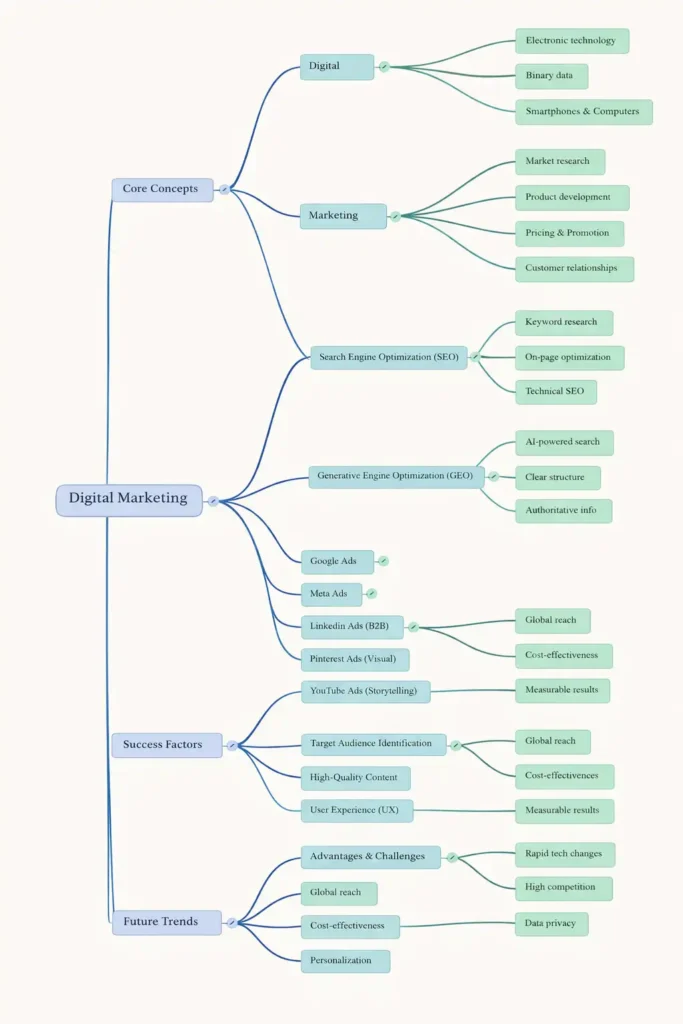
Digital marketing has revolutionized the way businesses promote their products and interact with customers. By combining digital technology with marketing strategies, companies can reach wider audiences, build stronger relationships, and achieve measurable results.
Understanding the concepts of digital and marketing individually helps clarify how digital marketing functions as a modern promotional system. Organic marketing methods such as SEO, GEO, content marketing, and social media engagement help businesses build long-term credibility, while paid marketing methods such as Google Ads, Meta Ads, LinkedIn Ads, Pinterest Ads, and YouTube Ads provide immediate visibility and faster results.
When these strategies are used together effectively, they create a powerful marketing ecosystem that supports sustainable business growth in the digital era.

Top Courses
Top Locations
- Digital Marketing Course in Faridabad
- Digital Marketing Course in Delhi
- Digital Marketing Course in Gurgaon
- Digital Marketing Course in Noida
- Web Development Course in Faridabad
- Web Development Course in Delhi
- Web Development Course in Gurgaon
- Web Development Course in Noida
- Graphic Design Course in Faridabad
- Python Course in Gurgaon
- SEO Course in Noida