Google Play
 App Store

Complete 2026 Career Guide | Skill For Career — Faridabad & Greater Noida
| �� Quick Answer Block What is Data Analysis? Data analysis is the process of collecting raw data, cleaning it, and turning it into clear insights that help businesses make smarter decisions. It covers four main types: Descriptive (what happened), Diagnostic (why it happened), Predictive (what may happen next), and Prescriptive (what action to take). How to Become a Data Analyst in India? Step 1: Learn Excel → Step 2: Learn SQL → Step 3: Learn Python (Pandas, NumPy) → Step 4: Learn Power BI or Tableau → Step 5: Build 3–5 real projects for your portfolio → Step 6: Do an internship → Step 7: Apply for fresher data analyst jobs. Key Facts at a Glance: • Who can apply: Any graduate — B.Com, BCA, BA, B.Sc, B.Tech — or even 12th-pass with a strong portfolio • Fresher salary in India: ₹2.5 to ₹5 LPA (Delhi NCR: ₹3–4.5 LPA) • Time to become job-ready: 3–6 months with focused, structured practice • Top tools: Excel, SQL, Python, Power BI, Tableau • Best places to find courses near you: Faridabad, Greater Noida, Delhi NCR (online + offline available) • Top industries hiring in India: Fintech, E-commerce, Healthcare, EdTech, Logistics, Retail • Is a degree required? No. Portfolio + skills matter more than college name in most Indian fresher hiring. |
Every time you tap on Swiggy, make a UPI payment, or browse Flipkart and close it without buying anything — that interaction gets recorded. Somewhere. And the companies behind those apps are paying people good money to make sense of that data.
That person is a data analyst.
If you have been wondering what data analysis actually is, whether it makes sense as a career choice in India right now, or how someone with zero coding background can get into this field — this guide covers all of it. In plain language, without the usual jargon.
At Skill For Career — our institute is based in Faridabad and Greater Noida, serving students from across Delhi NCR, Haryana, and UP — we have put hundreds of students through our data programs and watched them land real jobs. So everything you read here comes from ground-level experience, not theoretical advice.
Table of Contents
- 1. What is Data Analysis?
- 2. Why Data Analysis is Booming in India Right Now
- 3. What Does a Data Analyst Actually Do All Day?
- 4. Data Analyst vs Data Scientist — The Real Difference
- 5. Skills You Need (Honest Breakdown)
- 6. Tools Every Data Analyst Must Know
- 7. Data Analyst Salary in India — Fresher to Senior
- 8. Who Can Become a Data Analyst? (Eligibility)
- 9. Step-by-Step Roadmap to Become a Data Analyst in India
- 10. How Long Does It Take?
- 11. Common Mistakes to Avoid While Learning
- 12. Career Paths After Data Analysis
- 13. Frequently Asked Questions
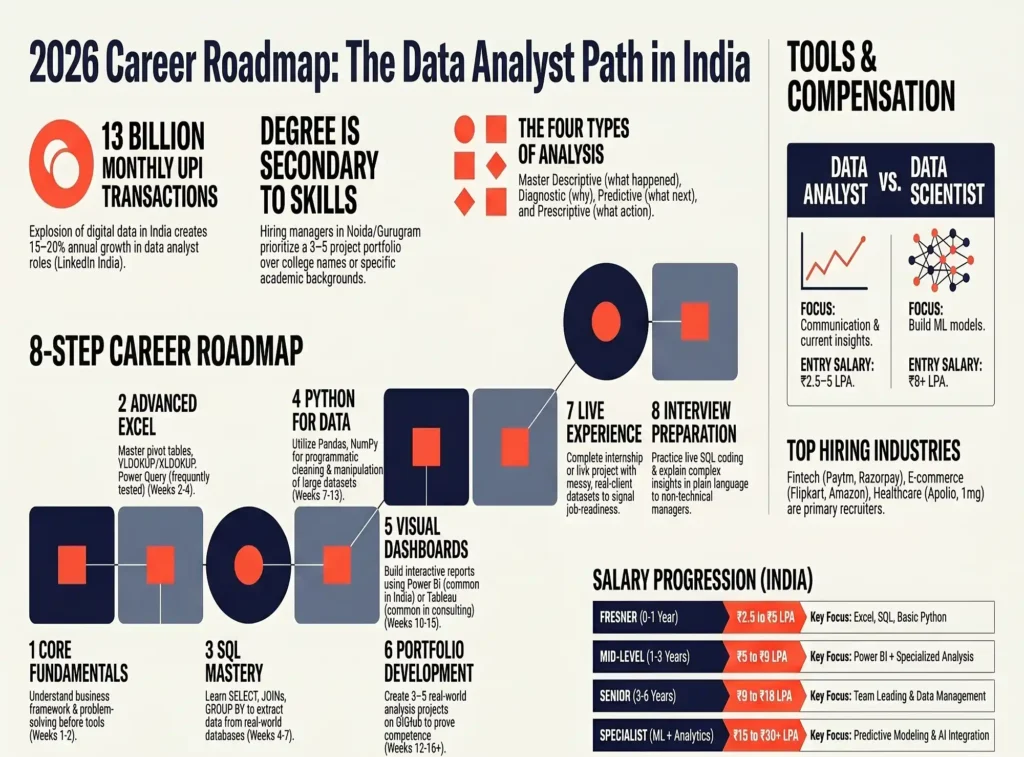
1. What is Data Analysis?
Data analysis is the process of taking raw data—which in its original form is usually a mess—cleaning it up, studying it carefully, and pulling out conclusions that actually help a business move forward.
Here is a simple example. A clothing brand notices its March sales dropped 30%. Without data, the manager guesses: maybe the product quality dropped, maybe the ads were not working, maybe it was just a slow season. With a data analyst on the team, someone pulls the actual sales records, compares them week by week, cross-references website traffic, ad spend, and return rates, and comes back with: ‘Sales dropped because your Facebook campaign was paused for 12 days. That single channel drove 68% of your March orders.’
That is data analysis. It turns confusion into answers.
The Four Types of Data Analysis
| Type | What It Answers |
| Descriptive Analysis | What happened? (Sales dashboards, weekly summaries, reports) |
| Diagnostic Analysis | Why did it happen? (Root cause investigation, comparing variables) |
| Predictive Analysis | What is likely to happen next? (Forecasting using historical data) |
| Prescriptive Analysis | What should we do about it? (Actionable recommendations from data) |
In our Complete Program in Data Analysis at Faridabad and Greater Noida, students work through all four types using actual business datasets — not cleaned-up textbook examples.
2. Why Data Analysis is Booming in India Right Now
India has over 900 million internet users. UPI crossed 13 billion transactions a month. E-commerce, OTT streaming, digital lending, EdTech — every one of these industries creates data every single second. And most companies, from a startup in Noida to an MNC in Gurugram, are sitting on all this data without enough people who know how to read it.
LinkedIn India shows data analyst roles growing at roughly 15–20% per year. Platforms like Naukri and Internshala consistently show thousands of open positions, many asking for candidates with 0–2 years of experience. The gap between demand and supply is wide — and that is your opportunity if you are willing to build the right skills.
Industries actively hiring data analysts across India include:
- Banking and Fintech: HDFC, Razorpay, Paytm, ICICI
- E-commerce: Flipkart, Amazon, Meesho, Nykaa
- Healthcare: Apollo, PharmEasy, 1mg
- EdTech, Logistics, Retail: growing demand across pan-India companies
And the demand is no longer limited to Bengaluru. Companies in Delhi NCR, Noida, Faridabad, Gurugram, Hyderabad, Pune and smaller cities are all hiring — which means students from Haryana, UP, and nearby areas have a genuine local advantage right now.
| �� Looking for Data Analysis courses near you? Skill For Career offers both offline classroom training in Faridabad (NIT-3) and Greater Noida (Galaxy Blue Plaza), plus online live classes for students across Delhi, Gurugram, Noida, Ghaziabad, Ballabhgarh, Palwal, Sonipat, and anywhere in India. |
3. What Does a Data Analyst Actually Do All Day?
Most people imagine a data analyst sitting in front of a glowing dashboard, watching charts update in real time. The actual job is more grounded — and honestly more interesting — than that.
A typical day involves:
- Pulling data from multiple sources — databases, Google Sheets, CRM tools, sales reports
- Cleaning the data — fixing wrong entries, filling gaps, removing duplicates
- Running queries to answer specific business questions
- Building charts and dashboards that non-technical managers can actually understand
- Presenting findings in plain language to teams who do not know Python or SQL
| Real Example: How Our Student Himani’s First Week Looked Himani completed our data analysis program in Faridabad and joined a Delhi NCR company as a junior data analyst. Her first task? Find out which city was generating the most repeat customers for her company’s e-commerce business.She pulled data from the SQL database, cleaned it in Python (removed duplicates, handled null values), ran a GROUP BY query, built a bar chart in Power BI, and presented it in the weekly team meeting. That ‘simple’ task took about three hours of careful work — and it was one of the most useful things the marketing team got that week.That is a data analyst’s job on a normal Tuesday. It is part detective, part communicator, part problem-solver. |
4. Data Analyst vs Data Scientist — The Real Difference
This is one of the most common questions students ask before deciding which path to take. Here is the honest answer.
| Data Analyst | Data Scientist | |
| Focus | Understanding what data says & communicating it clearly | Building ML models & predictive systems |
| Tools | Excel, SQL, Python (basics), Power BI, Tableau | Advanced Python, scikit-learn, TensorFlow, R |
| Math needed | Basic statistics (mean, correlation, regression) | Advanced statistics, linear algebra, calculus |
| Entry difficulty | More accessible — good starting point | Requires stronger math & more experience |
| Job availability | Very high — most companies need analysts | Fewer roles, more competitive |
| Salary (India) | ₹2.5–18 LPA depending on experience | ₹8–30+ LPA at senior/specialist levels |
One thing most coaching centres in Delhi NCR and Faridabad do not tell students upfront: most Indian companies hire far more data analysts than data scientists. The analyst role is more accessible, pays well at every stage, and gives you a much clearer path from zero to employed.
Our Complete Program in Data Analysis at Skill For Career is built around this reality — it gives you strong analyst skills first, then introduces ML concepts so you know where the field is heading, without overwhelming you at the start.
We also offer a Basic Course in AI and an Advanced Course in AI that pair naturally with data training for students who want to move toward data science later.
5. Skills You Need to Become a Data Analyst (Honest Breakdown)
Technical Skills
- Excel — Still the most widely used tool inside Indian companies, particularly in finance, HR, and operations. You need advanced Excel: pivot tables, VLOOKUP/XLOOKUP, Power Query, and macros.
- SQL — Every company stores its data in databases. SQL is how you pull that data out. It is non-negotiable and appears in nearly every data analyst job description in India.
- Python — For cleaning large datasets and doing statistical work. The libraries that matter are Pandas (data manipulation), NumPy (calculations), Matplotlib and Seaborn (visualisation).
- Power BI or Tableau — For building dashboards that managers and clients can interact with. Power BI is dominant in most Indian companies; Tableau is popular in product firms and consulting.
- Basic Statistics — Mean, median, correlation, regression. You do not need a math degree — you just need to understand these concepts well enough to apply them correctly and not misread results.
Non-Technical Skills (Just As Important)
- Communication — If you cannot explain a complex finding in two sentences to a non-technical manager, your analysis has no impact.
- Problem-solving — Data gives you clues. You still have to ask the right questions and know which direction to dig.
- Attention to detail — One wrong formula in Excel can push a business toward an entirely wrong decision. Accuracy is not optional.
- Business understanding — The best analysts understand what the business is actually trying to achieve — not just how to run a query.
And here is the good news for students from Faridabad, Noida, Delhi, or anywhere in India without a technical background: none of these require a specific degree. Our students come from commerce, arts, science, and even non-IT jobs. What they share is curiosity and willingness to put in real practice.
6. Tools Every Data Analyst Must Know
Based on what companies in Delhi NCR, Noida, Faridabad, Gurugram and across India are actually asking for in job descriptions right now, here are the tools that show up again and again:
| Tool | Why It Matters |
| Microsoft Excel | Advanced pivot tables, Power Query, XLOOKUP. Still tested in most Indian analyst interviews. |
| SQL | SELECT, JOINs, GROUP BY, subqueries. Every analyst job asks for this — no exceptions. |
| Python (Pandas, NumPy, Matplotlib) | For cleaning, analysing, and visualising data programmatically. |
| R | Used in research, healthcare, and academic settings. Some niche roles prefer it over Python. |
| Power BI | Microsoft’s BI tool. DAX formulas and automation add serious value. Very common in Indian companies. |
| Tableau | Strong visual storytelling. Popular in product companies and consulting firms. |
| Google Analytics | Essential for companies with digital products or e-commerce. |
| ETL Tools + Cloud Basics | Alteryx, Talend for pipelines; basic AWS or Azure familiarity is increasingly expected. |
At Skill For Career, students get hands-on practice with all of these tools throughout the program. By Phase 8, students are working on live client projects with real messy data — not clean sample files — which is what actually prepares you for an interview.
7. Data Analyst Salary in India — Fresher to Senior
Let us talk numbers.
| Experience Level | Salary Range in India |
| Fresher (0–1 year) | ₹2.5 to ₹5 LPA | Delhi NCR roles often start at ₹3–4.5 LPA for freshers with strong tool skills |
| Mid-level (1–3 years) | ₹5 to ₹9 LPA | Specialisation helps — Power BI + Python + SQL commands more than Excel alone |
| Senior Analyst (3–6 years) | ₹9 to ₹18 LPA | Moves into Business Analyst, Analytics Lead, or Data Manager territory |
| ML + Analytics (Specialist) | ₹15–30+ LPA | For those who bridge into data science with ML experience |
One thing worth knowing: salary in this field does not depend heavily on which college you attended. It depends on your portfolio, the projects you can show, and how you perform in a technical test. That levels the playing field for students from Faridabad, Ballabhgarh, Noida, or any city — if you can show real skills, the degree name on your certificate does not matter much to most hiring managers.
Several of our students who completed the Complete Program in Data Analysis placed in Delhi NCR companies within 60–90 days — including Himani and Ritika Verma, both now working as Data Analysts.
8. Who Can Become a Data Analyst? (Eligibility)
Different coaching institutes give different answers on this, which confuses a lot of students. Here is the straight version:
- Minimum Qualification: Any graduate — B.Com, BCA, B.Sc, BA, B.Tech — can become a data analyst. Even 12th-pass students with a strong portfolio and solid practice have found entry-level roles.
- Stream: No hard requirement for science or math. Commerce students already understand business context, which is a real advantage. Arts students who are analytical pick up tools just as well.
- Age: No age limit. We have trained freshers right out of college and professionals in their 30s making a career switch. Both have placed successfully.
- Prior Programming Experience: Not required. The curriculum starts from scratch — Phase 1 covers fundamentals before any tool is introduced.
| The real eligibility requirement?Basic computer knowledge, access to a laptop, and willingness to practice consistently. If you have those three things, you can become a data analyst. |
9. Step-by-Step Roadmap to Become a Data Analyst in India
This is the exact path we walk students through at Skill For Career — mapped against what the job market actually rewards.
Step 1 — Understand the Fundamentals (Week 1–2)
Before touching any tool, get your head around what data analysis is, what types of data exist, how analysts think through a business problem, and what a proper analytics framework looks like. This context makes everything that follows faster and stickier.
Step 2 — Master Excel First (Week 2–4)
Excel is still the most used tool in Indian offices. Learn pivot tables, VLOOKUP and XLOOKUP, Power Query, and basic charting. Many freshers skip this step and regret it. Entry-level analyst roles across Delhi NCR frequently test Excel before anything else — even before SQL.
Step 3 — Learn SQL (Week 4–7)
SQL is non-negotiable. Start with basic SELECT queries, then move to JOINs, GROUP BY, subqueries, and aggregation functions. Practice on free platforms like HackerRank, or download a sample database and run your own queries against it. SQL is how you extract data from real company systems.
Step 4 — Pick Up Python for Data (Week 7–13)
Start with core Python, then move to Pandas for handling datasets, NumPy for calculations, and Matplotlib or Seaborn for charts. Work with real datasets from the start — Kaggle has hundreds of free public datasets. Avoid staying only in tutorials; the moment you struggle with a real dataset is when the learning actually kicks in.
Step 5 — Learn Power BI or Tableau (Week 10–15)
Build at least three complete dashboards from scratch. The ability to present data visually is what gets your work in front of decision-makers. Power BI is more common in Delhi NCR and Faridabad-area companies; Tableau shows up more in product firms and consulting.
Step 6 — Build a Portfolio (Week 12–16 onward)
This is what most coaching centres skip — and it costs their students jobs. Without a portfolio, you are just another certificate holder. Build 3–5 analysis projects that solve an actual business question. Put them on GitHub. Write a short PDF report for each one that explains your findings in business language. That is what employers actually look for.
Step 7 — Get Real-World Experience (Internship or Live Project)
Nothing signals job-readiness to an interviewer better than having worked on actual data from a real company. Our Complete Program in Data Analysis includes a 30-day live project phase with real client datasets, plus an internship certificate from our partner companies — because we know how much it matters in Delhi NCR hiring.
Step 8 — Prepare for Interviews
Practice SQL questions (interviewers love testing this live), prepare to walk through a portfolio project step by step, and practice explaining analysis in plain language to a non-technical interviewer. At Skill For Career, our placement team runs mock interviews and resume reviews before your job search even begins.
10. How Long Does It Take to Become a Data Analyst?
Realistic expectations, honestly:
| Phase | Timeline |
| Structured training (all tools covered) | 3 months |
| Live project period (real portfolio work) | 30 days |
| Active job applications + interview prep | 2–4 weeks |
| First job offer (typically) | 60–90 days after training completion |
People who try to learn purely from YouTube without structure often take 12–18 months — and still have gaps that show up badly in interviews. The difference is not intelligence. It is that unstructured learning naturally skips the hard parts: data cleaning, SQL complexity, building dashboards from scratch. And those are exactly the things employers test.
If you are in or near Faridabad, Greater Noida, Delhi, or anywhere in NCR and want to compare options: our 3-month Complete Program in Data Analysis covers the full journey — tools, live projects, internship certificate, and placement support — at ₹19,999 (currently at 50% off: ₹15,999 this May). Both online and offline sessions available.
11. Common Mistakes Students Make While Learning Data Analysis
We see the same mistakes across hundreds of students. Knowing them upfront saves you months of going in the wrong direction.
Mistake 1 — Collecting Certificates Instead of Skills
Finishing a Coursera course and adding it to LinkedIn does not make you a data analyst. Companies test skills during the interview — live SQL queries, live dashboard exercises, live data problem-solving. A certificate proves you started a course. Your portfolio proves you can do the work.
Mistake 2 — Skipping Data Cleaning
Real-world data is messy. Inconsistent formats, missing values, duplicate entries, typos — 60 to 70% of an analyst’s actual job is cleaning data before any analysis begins. Students who only practice on clean datasets are genuinely unprepared for real work.
Mistake 3 — Learning Tools Without Business Context
Knowing how to run a SQL query is not enough. You need to understand why you are running it and what business decision it supports. An analyst who understands both the technical side and the business side is worth significantly more to an employer.
Mistake 4 — No Portfolio
If you cannot show your work, an employer has no reason to believe you can do it. Build projects. Publish them publicly. Show your thinking process, not just the final chart.
Mistake 5 — Avoiding Communication Practice
Data analysis is not a solo activity. Every insight eventually needs to be explained to someone who does not know Python. Practice writing about your findings in plain language. Practice presenting in front of others. This is what separates analysts who get promoted from those who stay junior.
12. Career Paths After Data Analysis
Data analysis is not just a job title — it is the foundation for several strong career directions. Here is where analysts typically go:
| Career Path | What It Involves |
| Business Analyst | Translating business requirements into data problems. Strong demand in banking, consulting, and product companies. |
| Data Engineer | Building the pipelines and systems that collect and store data. More technical, higher salary. |
| Data Scientist | Extending into machine learning and predictive modelling. Natural progression for analysts who enjoy the statistical side. |
| Analytics Manager / Data Lead | Leading a team of analysts. Requires both technical depth and people management. |
| Product Analyst | Specialising in product usage data for tech and SaaS companies. Very strong demand in startups. |
| BI Developer | Building dashboards and reporting systems. Power BI and Tableau expertise is central. |
If you want to expand into adjacent areas, Skill For Career also offers an Advanced Course in Data Analysis, plus Basic and Advanced AI Courses that build naturally on data training.
For students from a development background who want to add analytics to their profile, our Web Development courses — including Full Stack programs in Python, MERN, and Java — are strong complements to a data career.
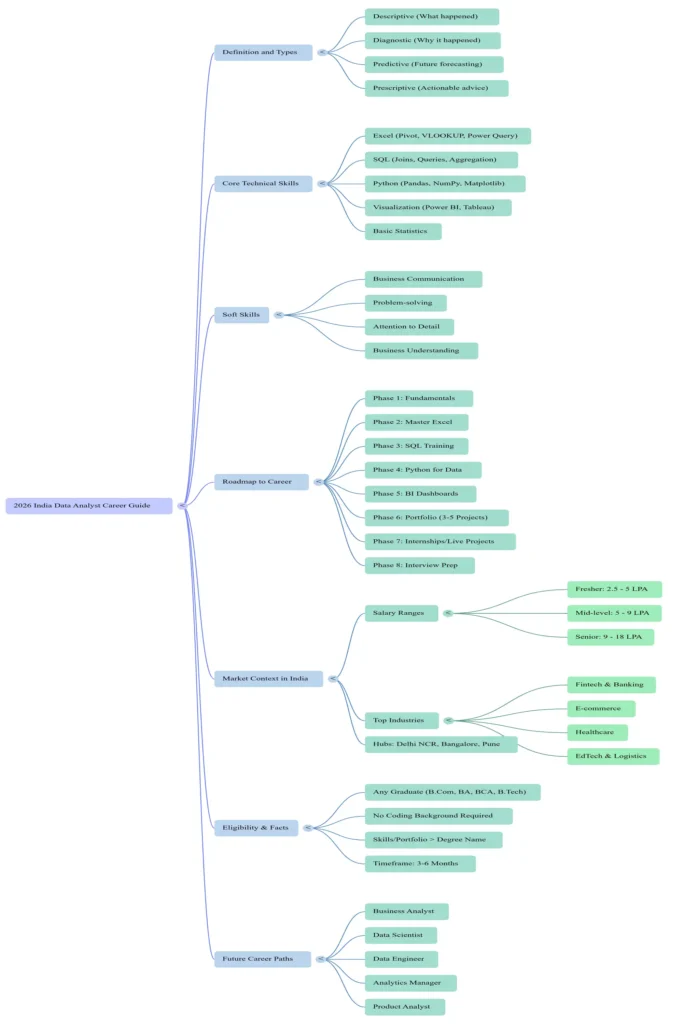
13. Frequently Asked Questions
Can a commerce student become a data analyst in India?
Yes, without any doubt. Commerce students already understand business processes, accounting logic, and financial data — which is a genuine advantage in many analyst roles. The tools are learnable. Deep business understanding takes years to develop, and commerce students already have a head start on that.
Is data analysis a good career in India in 2026?
Yes. Demand is growing faster than supply. Salaries are strong at every level from fresher to senior. The work is intellectually engaging. And unlike many IT roles, it is not easily automated or outsourced, because interpretation and communication require human judgement that tools cannot replace.
Do I need a degree to become a data analyst?
No formal degree is specifically required. What employers test is your ability to work with SQL, Python, and BI tools — and your ability to explain your findings. A strong portfolio matters more than a college name in most Indian fresher hiring, especially for analyst roles in Delhi NCR and Faridabad-area companies.
Which tool should I learn first — Excel, SQL, or Python?
Start with Excel if you have no background at all. Then SQL. Then Python. Each one builds on the previous, and each one shows up in interview tests. Jumping straight to Python without Excel or SQL creates gaps that surface badly when companies give you a live assessment.
What is the difference between data analysis and data analytics?
They refer to the same field. Data analysis is the process; data analytics is the broader discipline. In Indian job descriptions, both terms are used interchangeably. Do not overthink this one.
How do I get my first data analyst job with no experience?
Build a portfolio of 3–5 projects using public datasets. Do an internship, even a short one. Get a structured course certificate from a credible institute. Apply for junior analyst, business analyst trainee, and analyst intern positions to start. Entry-level roles in Delhi NCR, Noida, and Faridabad are consistently available for candidates with solid portfolio work.
Can I learn data analysis online?
Yes. A mix of structured offline and online training tends to produce better results for most students — you stay accountable and get live doubt-clearing. Skill For Career offers both live online sessions and offline classroom training at our Faridabad and Greater Noida centres.
Are there data analysis courses near me in Faridabad or Greater Noida?
Yes. Skill For Career runs offline batches in Faridabad (NIT-3, near DAV College) and Greater Noida (Sector 4, Galaxy Blue Plaza). We also serve students from Delhi, Gurugram, Noida, Ghaziabad, Ballabhgarh, Palwal, Sonipat, and beyond through our online live classes. Call +91 922-0403-922 to check current batch schedules.
Final Thoughts
Data analysis is one of the most accessible high-paying career paths open to Indian students in 2026. You do not need a premium college, an engineering degree, or lakhs in fees. You need the right tools, real projects, honest practice, and a clear picture of what employers actually look for.
At Skill For Career, the Complete Program in Data Analysis is built around exactly that — 9 structured phases covering everything from Excel fundamentals to live client projects, with placement support that continues for a year after completion. Over 600 students have enrolled, the course holds a 4.9-star rating, and students like Himani and Ritika Verma are now working as Data Analysts in Delhi NCR companies.
| �� Ready to start? Reach us here:Phone / WhatsApp: +91 922-0403-922Faridabad Branch: 3H-47, Near DAV College, NIT-3, Faridabad, HaryanaGreater Noida Branch: 3rd Floor, Galaxy Blue Plaza, Sector 4, Greater Noida, UPOnline: Pan-India live classes — attend from Delhi, Gurugram, Noida, Ghaziabad, Ballabhgarh, or anywhere in India View the Complete Program in Data Analysis → |
Related Posts You Should Read Next
- Best Short-Term Courses with High Salary in India 2026
- Digital Marketing Course After 12th — Complete Career Guide
- Best Medical Coding Institute in Faridabad & Delhi
- AI Courses with Certification by Skill For Career
Published by Skill For Career | MSME-Certified, GST-Registered EdTech Institute (GST: 06CEWPB0138N1Z8) | Faridabad & Greater Noida


Top Courses
Top Locations
- Digital Marketing Course in Faridabad
- Digital Marketing Course in Delhi
- Digital Marketing Course in Gurgaon
- Digital Marketing Course in Noida
- Web Development Course in Faridabad
- Web Development Course in Delhi
- Web Development Course in Gurgaon
- Web Development Course in Noida
- Graphic Design Course in Faridabad
- Python Course in Gurgaon
- SEO Course in Noida